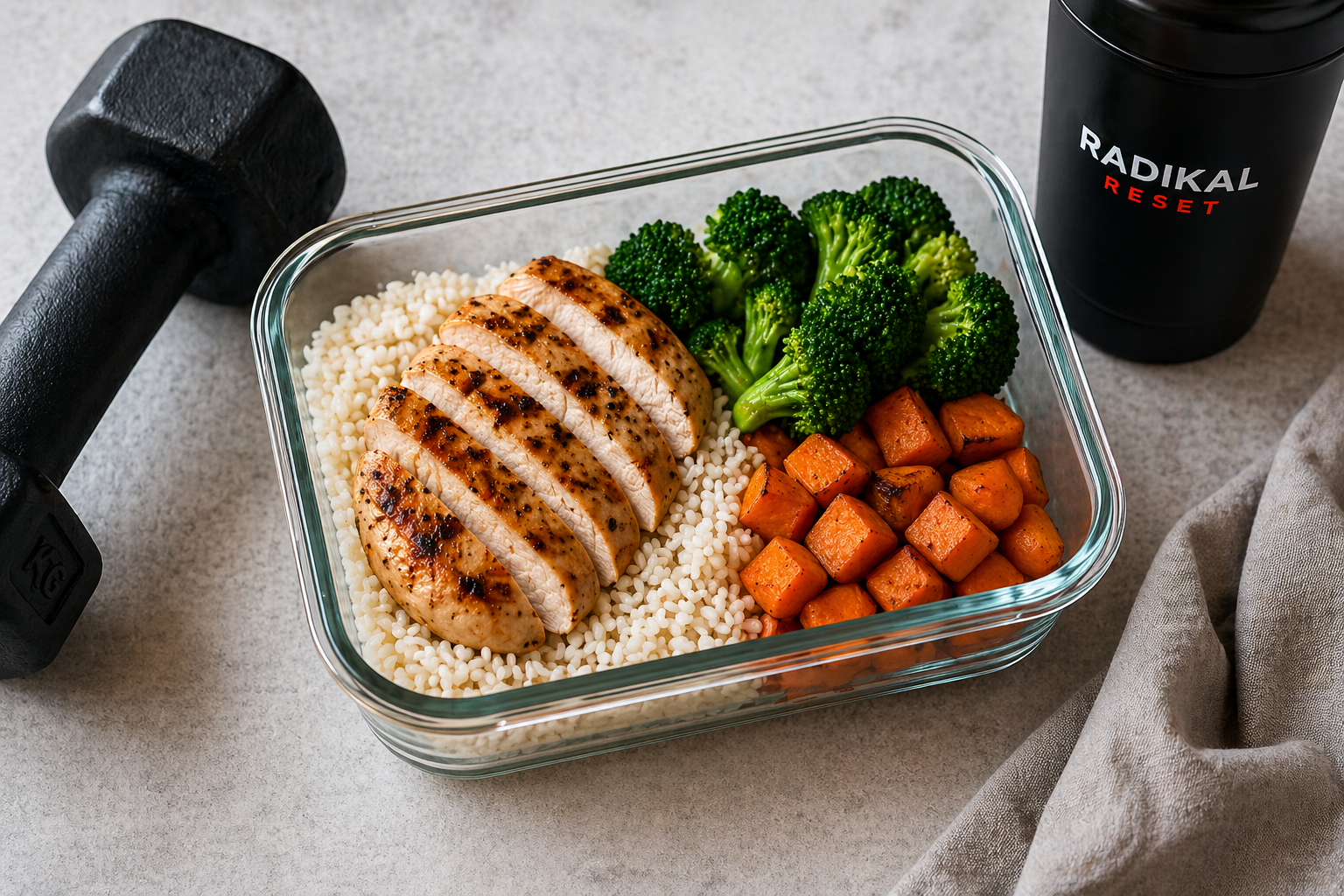
How to calculate your calories to lose fat without going crazy.
You do not need to obsess over every gram forever. But understanding your calories can help you stop guessing, control fat loss and adjust your plan without panic.
Calories are not the whole story, but they are part of the story. If you want to lose fat, your body needs to use more energy than it takes in over time. That does not mean you need to become obsessive. It means you need enough awareness to stop eating completely blind.
The problem is that many people treat calories in two extreme ways: either they ignore them completely, or they track everything so aggressively that food becomes stressful. The useful middle ground is learning how calories work, using them as a tool, and then building repeatable meals around that understanding.
Use calories to create clarity, not obsession.
Counting calories can be useful for a short period because it shows you what is really happening. But the final goal is not to live inside an app. The goal is to understand portions, protein, snacks, oils, drinks and patterns well enough to make better decisions.
A simple way to estimate your fat-loss calories
This is not a perfect formula. No formula is. It gives you a starting point that you can adjust based on real progress.
Estimate your maintenance calories
Maintenance calories are roughly the calories your body needs to maintain your current weight. A simple starting estimate is:
Use the lower end if you are less active. Use the higher end if you train and move more.
Create a moderate deficit
Once you have an estimated maintenance number, subtract a moderate amount:
This is usually more repeatable than cutting too aggressively from day one.
Track the trend, not one day
Your first target is only a starting point. Use 2-3 weeks of data before making big changes. Weight can move up and down because of water, salt, digestion, menstrual cycle, stress and training.
Your calorie target is a starting point, not a prison.
The number helps you start. Your real progress tells you whether to adjust. Do not treat a formula as more important than what your body and your week are showing you.
Example calculation
Imagine someone weighs 80 kg and trains a few times per week but does not move a lot outside the gym.
80 × 30 = around 2,400 calories.
2,400 – 400 = around 2,000 calories.
Review after 2-3 weeks of consistent tracking.
How much protein should you eat?
Calories control the direction of fat loss, but protein helps the process feel easier and supports muscle retention. A practical range for many people is:
You do not need to hit the exact number perfectly. Start by adding a clear protein source to each main meal.
What to track without becoming obsessive
Tracking can be useful, but it does not need to control your life. Start with the variables that give you the most clarity.
Use weekly averages instead of reacting to one weigh-in.
Make sure your meals are not just carbs and fats with little protein.
Oils, sauces, drinks, snacks, nuts and weekend meals often matter.
Low movement can slow progress even when your diet looks good.
When should you adjust calories?
One high-salt meal, one stressful day or one hard workout can affect the scale temporarily.
If your weekly average does not change after 2-3 consistent weeks, then adjust.
Reduce 100-200 calories, increase steps, or improve accuracy before making extreme changes.
Common calorie mistakes
- Choosing a target that is too low and then bingeing later.
- Tracking Monday to Thursday but ignoring weekends.
- Forgetting oils, sauces, drinks and snacks.
- Changing calories every few days instead of watching the trend.
- Using exercise calories as permission to eat much more.
- Thinking calories matter but protein, fiber and food quality do not.
Related guides
Continue with these guides if you want fat loss to feel less confusing.
Radikal Reset helps you organize nutrition, training and habits without guessing.
Calories matter, but the full process works better when they are connected to meals, training, movement and weekly consistency.