• Person strength training in a bright gym with a stationary bike in the background and dumbbells nearby

    Cardio or Weights for Fat Loss: What Should You Prioritize?

    If you want to lose fat, it is normal to wonder what you should prioritize: cardio or weights. Many people think cardio “burns fat” and weights are only for building muscle, but that view is too limited.

    The reality is that both cardio and weights can help you, but they serve different roles. The mistake is choosing one as if the other does not matter, or doing too much of everything without a clear structure.

    Quick answer

    For fat loss, you should prioritize weights or strength training to maintain muscle and improve body composition, and use cardio as a complement to increase expenditure, cardiovascular health, and adherence. Fat loss will still depend mainly on a calorie deficit and consistency.

    Note: this content is informational and does not replace individualized medical, nutrition, or training advice. If you have pain, a previous injury, or a medical condition, consult a qualified professional before starting.

    Fat loss is not about choosing cardio or weights

    Fat loss mainly depends on maintaining a calorie deficit for long enough. That can come from eating better, moving more, training better, or combining everything intelligently.

    The useful question is not “what burns more calories in one session,” but what combination helps you lose fat without losing muscle, burning out, or quitting.

    Weights protect muscle

    They help maintain muscle mass while you lose fat.

    Cardio increases expenditure

    It can make the deficit easier and improve cardiovascular health.

    Food matters a lot

    Without aligned nutrition, neither weights nor cardio can compensate for chaos.

    Why weights should be the foundation

    When you lose weight, you do not want to lose just any weight. You want to lose fat while keeping as much muscle as possible. Strength training is key here.

    1. It improves body composition

    Two people can weigh the same and look very different. Strength helps the change become more than just losing kilos.

    2. It helps maintain muscle in a deficit

    If you eat less and do not give your muscles a reason to stay, your body has fewer reasons to keep them.

    3. It makes the process more sustainable

    Strength training 3 or 4 days per week is usually easier to sustain than living on extreme cardio.

    So what is cardio for?

    Cardio is not bad or unnecessary. The problem is using it as punishment for eating or as the only tool for fat loss. Used well, it is an excellent complement.

    • It increases energy expenditure without forcing you to cut as much food.
    • It improves cardiovascular health and general fitness.
    • It can reduce stress if you choose manageable intensity.
    • It helps build routine, especially through daily walks.

    How to combine cardio and weights for fat loss

    Simple beginner option

    Do 3 strength sessions per week and add daily walks or 2 easy cardio sessions. This is usually enough to start without burning out.

    Intermediate option

    Do 3–4 strength sessions, 2–3 moderate cardio sessions, and control daily steps. Cardio should support the plan, not ruin recovery.

    If you have little time

    Prioritize strength and steps. If you can only choose one thing in the gym, start with strength. Cardio can come through walks or short sessions.

    Common mistakes when combining cardio and weights

    Doing so much cardio that you cannot recover

    More is not always better. If cardio leaves you without energy for strength, it may be hurting the plan.

    Using cardio as punishment

    Training to “pay for” meals often creates a chaotic relationship with the process.

    Forgetting nutrition

    Neither weights nor cardio work well if your food does not support the goal.

    Frequently asked questions

    Can I lose fat with weights only?

    Yes, if your nutrition creates a deficit. Cardio is not mandatory, but it can help.

    Can I lose fat with cardio only?

    You can lose weight, but without strength training it is easier to lose muscle and miss the look you want.

    What should I do first, cardio or weights?

    If your priority is body composition, it usually makes sense to do strength first and cardio after or on separate days.

    You may also find useful

    Next step

    You do not need to choose between cardio and weights. You need a structure that combines what matters.

    Radikal Reset is designed to help you organize training, activity, nutrition, and habits without improvising every week.

    See Radikal Reset
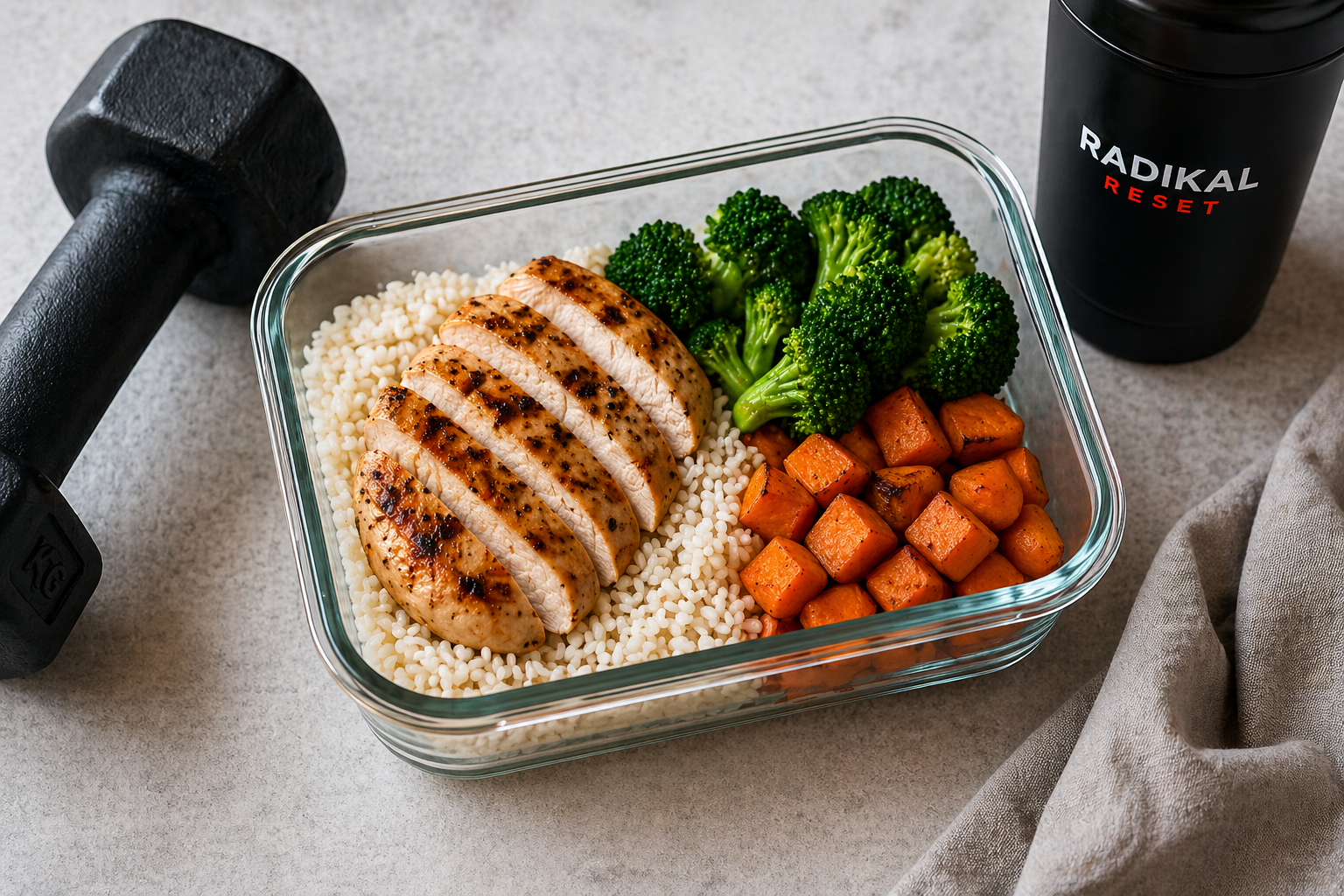
  • Healthy meal prep container with grilled chicken, rice, broccoli and sweet potato next to a dumbbell and a shaker

    How to Calculate Your Calories to Lose Fat Without Going Crazy

    Calculating calories to lose fat does not have to become an obsessive process or a life sentence of checking apps and scales all day. Used properly, it is simply a way to guide yourself toward eating a little less than you burn without doing it blindly.

    The problem is that many people approach this in an extreme way: either they try to calculate everything down to the gram, or they leave everything to chance. Usually, neither approach helps much.

    Quick answer

    To lose fat, you need to eat slightly less than you burn, keep protein at a reasonable level, and maintain that process long enough. You do not need a perfect number. You need the right direction and enough consistency.

    Note: this content is informational and does not replace individualized medical, nutrition, or training advice. If you have a medical condition or specific needs, consult a qualified professional.

    What calculating calories really means

    It means having an approximate reference for how much you eat and what intake might help you start losing fat. It is not a magic number or an absolute truth. It is a useful starting point.

    Daily expenditure

    This is an estimate of the energy you burn through metabolism, activity, and training.

    Calorie deficit

    This means eating a bit less than you burn in order to support fat loss.

    Adjustment

    The first number is rarely perfect. Normally, you adjust based on real progress.

    The 3 basic steps to calculate your calories

    1. Estimate your daily expenditure

    You can use an online calculator as an initial reference. It will not be exact, but it will usually be useful enough to get started.

    2. Create a small or moderate deficit

    In many cases, starting with around 10–20% below your estimated expenditure is enough. You do not need to slash calories hard to begin seeing change.

    3. Observe and adjust

    If two or three weeks pass and nothing changes, you adjust slightly. If you are losing too fast and feel terrible, you adjust too. This is more about correcting well than getting it perfect on day one.

    A simple example

    Imagine you estimate that your daily expenditure is around 2,400 calories.

    A reasonable starting point could be eating around 2,000–2,150 calories per day and watching what happens over the next two weeks. You do not need to obsess over hitting exactly 2,073. You need a useful reference.

    Key idea: fat loss usually depends less on mathematical perfection and more on maintaining the right direction with enough consistency.

    What matters more than counting every calorie

    Enough protein

    This helps you maintain muscle mass and makes the deficit easier to handle.

    Real and filling food

    If your diet is full of ultra-processed foods, the deficit usually feels much harder.

    Consistency

    A reasonable plan followed for weeks usually beats a perfect plan followed for three days.

    Common mistakes when calculating calories

    • Dropping calories too low and only lasting a few days.
    • Assuming your first number is exact and refusing to adjust.
    • Forgetting protein and focusing only on total calories.
    • Relying only on motivation instead of having structure.
    • Quitting because of one bad day as if that ruined everything.

    You do not need to go crazy to do this well

    Many people improve their process dramatically just by using a reasonable reference, a few repeatable meals, and a minimal structure. There is no need to turn every meal into a spreadsheet.

    What matters is not spending all day watching numbers. What matters is using a system that helps you sustain better decisions for long enough.

    Frequently asked questions

    Do I need to weigh all my food to lose fat?

    Not necessarily. It can help at first, but many people do well using reasonable estimates and repeating similar meals.

    How big should my deficit be?

    A small or moderate deficit usually works better than an aggressive one. The key is whether you can sustain it.

    What if I do not lose anything in the first week?

    Do not draw conclusions too fast. Look at two- or three-week trends before changing anything.

    You may also find useful

    Next step

    Losing fat usually does not require more obsession. It usually requires more structure.

    If you want to organize your calories, meals, and habits better without making life harder, Radikal Reset is designed for exactly that: turning nutrition theory into a clearer and more sustainable system.

    See Radikal Reset