• Three text-free visual paths symbolizing different training and body transformation routes.

    Radikal Reset Test: Discover Which Route You Need to Start

    Not everyone needs to start the same way. A person who has not trained for months does not need the same route as someone who already trains but feels disorganized. And someone who always quits in week two or three does not need more intensity: they need a structure they can sustain.

    This Radikal Reset test helps you identify which type of route fits you right now: a Base Route, a Standard Route or a Controlled Intense Route.

    This is not a medical diagnosis or a perfect assessment. It is a practical way to stop improvising and choose a realistic starting point.

    Note: this content is informational and does not replace individualized medical, nutrition, or training advice. If you have injuries, pain, a medical condition or major doubts, consult a qualified professional before starting.

    Quick answer

    Answer the questions, count whether you choose more A, B or C answers, and check your final result. Mostly A means you probably need a Base Route. Mostly B means a Standard Route. Mostly C means a Controlled Intense Route.

    How to take the test

    Read each question and choose the option that best matches your current situation. Do not answer based on your ideal version. Answer based on what you can actually do this week.

    • Count how many A, B and C answers you choose.
    • Do not try to look “better”. The test only works if you are realistic.
    • If you are between two options, choose the more conservative one.
    • At the end, check which letter appears most.

    Question 1: how long have you been inconsistent with training?

    A) Months or years. Even starting again feels hard.
    B) A few weeks or months, but I have trained before.
    C) I train sometimes, but without clear structure or progress.

    Question 2: how is your daily energy?

    A) Low. Moving, training or keeping a routine feels difficult.
    B) Irregular. Some days are fine and others disappear.
    C) Decent, but I need structure to use it well.

    Question 3: what usually breaks your attempts?

    A) I get overwhelmed, it feels too big, and I quit.
    B) I start well, but work, hunger, fatigue or social life throw me off.
    C) I lack progression, focus or a more serious structure.

    Question 4: how many days can you realistically train?

    A) 2 or 3 days if they are realistic and do not destroy me.
    B) 3 days most weeks if I know exactly what to do.
    C) 3 or 4 days if the plan is well organized.

    Question 5: how are you eating right now?

    A) Quite chaotic. I improvise a lot and struggle with hunger.
    B) Average. I do not eat terribly, but there are clear things to improve.
    C) Not bad, but I need to connect it better with training.

    Question 6: what happens when you miss a day?

    A) It is hard to return. I feel like I already ruined it.
    B) I can return, but sometimes it takes several days.
    C) I return fairly quickly, but I want better consistency.

    Question 7: what do you need most right now?

    A) Start moving again without quitting.
    B) Organize training, food and habits.
    C) A more serious plan with progression and controlled intensity.

    Result: mostly A — Base Route

    If you mostly chose A answers, you probably need a Base Route. You do not need to destroy yourself. You need to build continuity, basic strength and weekly movement without quitting in week two.

    Your priority is not training harder. It is getting back to completing the plan. Start with 2 or 3 realistic workouts, easy walks and very simple food rules.

    Your initial focus

    • Full-body workouts.
    • Moderate loads.
    • More steps, without obsessing over hard cardio.
    • Protein in main meals.
    • Main goal: finish the week, not prove anything.

    Result: mostly B — Standard Route

    If you mostly chose B answers, you probably need a Standard Route. You can move forward well, but you need to stop improvising.

    Your priority is building a repeatable week: 3 workouts, steps, base meals, enough protein and tracking without obsession.

    Your initial focus

    • 3 well-distributed weekly workouts.
    • Gradual progress in loads or reps.
    • 2 or 3 base meals to avoid improvising.
    • Walks or easy cardio as support.
    • Main goal: keep rhythm when motivation drops.

    Result: mostly C — Controlled Intense Route

    If you mostly chose C answers, you probably need a Controlled Intense Route. You already have some base, but you need direction, progression and a structure that does not depend only on motivation.

    You may tolerate more work, but that does not mean week one should become an ego test.

    Your initial focus

    • 3 or 4 workouts depending on recovery.
    • Clear progression in main exercises.
    • Intensity control, not destruction.
    • Simple but more precise nutrition.
    • Main goal: channel intensity without burning out.
    What matters

    Your route matters, but what matters most is having a structure.

    The problem for many people is not that they do not know they should train or eat better. The problem is that they do not have a clear route for their real starting point.

    Start my reset

    What to do now based on your result

    If you are Base Route

    Do not start at maximum intensity. Start with a week you can complete. Two workouts done are worth more than five imagined.

    If you are Standard Route

    Organize 3 workouts, 2 base meals and a simple way to track progress. Your enemy is improvisation.

    If you are Controlled Intense Route

    Use your energy, but do not turn the plan into a competition against yourself. Progressing is not destroying yourself.

    You may also find useful

    Frequently asked questions

    What if I get a tie between two routes?

    Choose the more conservative route for the first week. You can always increase demands later, but starting too hard often breaks continuity.

    Is the Base Route only for beginners?

    No. It may also be the best route if you are coming from a bad period, high stress, low energy or several failed attempts.

    Is the Controlled Intense Route better?

    Not necessarily. It is better only if you can recover, maintain technique and sustain the plan without burning out.

    Can I change route later?

    Yes. It is normal to start more conservatively and adjust based on energy, recovery, adherence and progress.

    You do not need to copy someone else’s route. You need to start from your real point.

    Radikal Reset is designed to help you train, eat and build habits with a structure that makes sense for your starting point.

    Start Radikal Reset
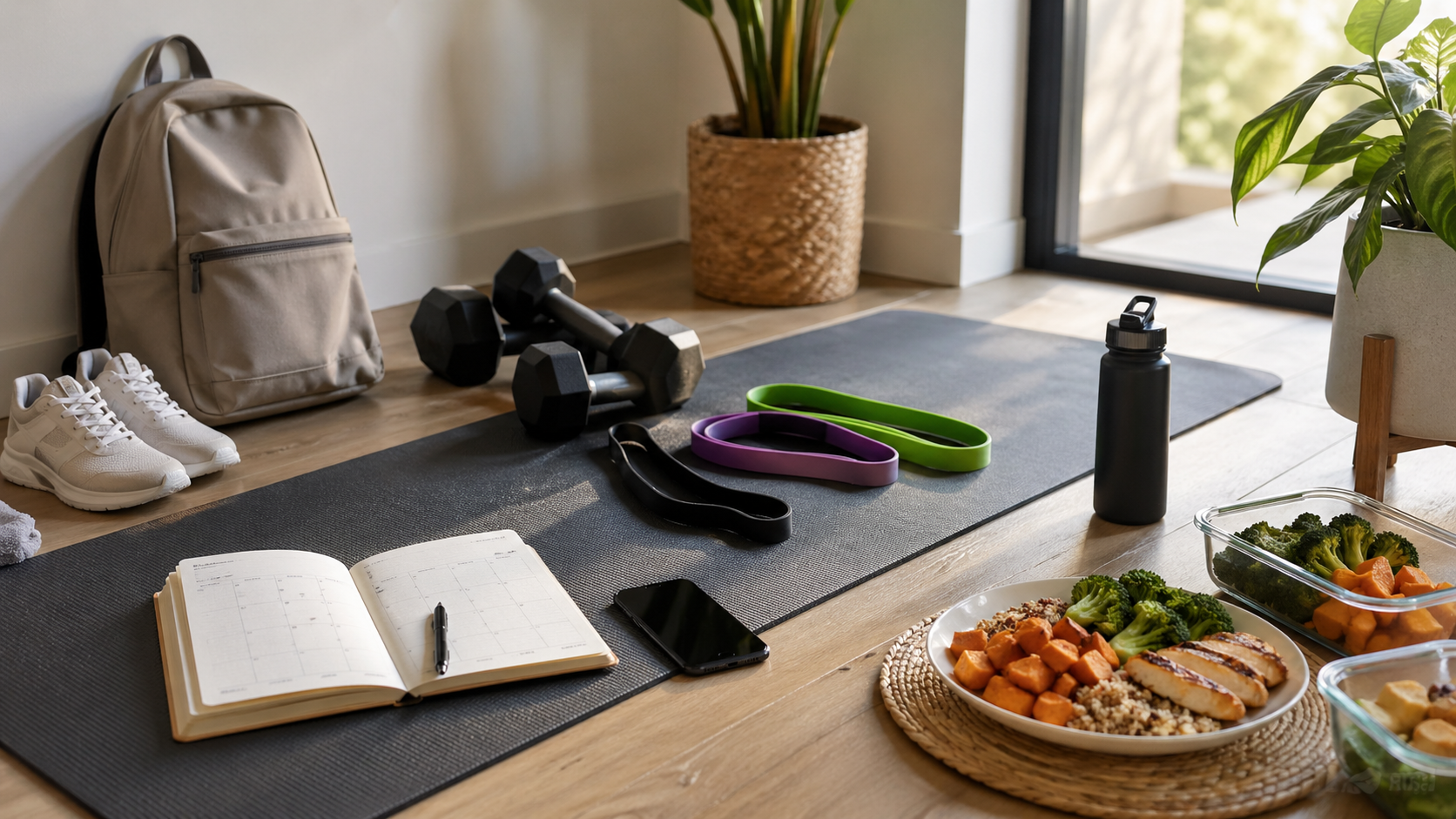
  • Text-free workout space with dumbbells, sneakers, backpack, exercise mat and healthy food prepared for week 1 of Radikal Reset

    Week 1 of Radikal Reset: Start HereS

    You do not need to change your whole life this week. You need to stop improvising.

    This Week 1 of Radikal Reset is designed to help you start with a simple structure: training, steps, basic food, and a realistic way to track progress.

    You do not need to do it perfectly. You need to start in a way you can repeat.

    Note: this content is informational and does not replace individualized medical, nutrition, or training advice. If you have injuries, significant joint pain or a relevant medical condition, adapt the exercises and consult a qualified professional before starting.

    Quick answer

    Week 1 of Radikal Reset means completing 3 workouts, walking more than usual, adding protein to your main meals, and tracking progress without obsessing. The goal is not to train like a beast: it is to finish the week thinking, “I can keep going.”

    Before you start: choose your situation

    Not everyone starts from the same place. This guide gives you two routes:

    Gym

    If you have access to machines, dumbbells, cables, a barbell or a treadmill.

    Home

    If you are starting with bodyweight, a backpack, bands or basic equipment.

    If you are very deconditioned, have a lot of weight to lose, or have not moved much for months, start with the easier version. That is not less valid. It is the smart entry point.

    The Week 1 rule

    Your goal this week is not to train like a beast. Your goal is to complete a realistic first week.

    • Train 3 days.
    • Walk more than usual.
    • Add protein to your main meals.
    • Do not compensate if you slip.
    • Track without obsessing.
    • Finish the week thinking, “I can keep going.”

    You are not trying to win a perfect week. You are trying to build a repeatable week.

    Week 1 plan

    • Monday: Workout 1.
    • Tuesday: walk or active recovery.
    • Wednesday: Workout 2.
    • Thursday: walk or mobility.
    • Friday: Workout 3.
    • Saturday: longer walk or easy activity.
    • Sunday: rest, review and prepare.

    If you cannot train Monday, Wednesday and Friday, that is fine. Use three separated days when you can. The important thing is to avoid placing all three workouts back-to-back if possible.

    Week 1 — gym option

    Workout 1 — Gym

    • Leg press or goblet squat — 3 sets of 8 to 12 reps.
    • Machine chest press — 3×8-12.
    • Seated row — 3×8-12.
    • Dumbbell Romanian deadlift — 2×10.
    • Lateral raises — 2×12-15.
    • Plank — 3 sets of 20-30 seconds.
    • Easy cardio — 10 minutes.

    Workout 2 — Gym

    • Hack squat, leg press or box squat — 3×8-12.
    • Lat pulldown — 3×8-12.
    • Machine shoulder press — 3×8-10.
    • Leg curl — 2×10-12.
    • Hip thrust or glute bridge — 3×10.
    • Machine or floor crunch — 3×12-15.
    • Easy cardio — 10 minutes.

    Workout 3 — Gym

    • Leg press or squat — 3×10.
    • Incline machine or dumbbell press — 3×8-12.
    • Supported row or seated row — 3×8-12.
    • Romanian deadlift or hip thrust — 3×10.
    • Biceps curl — 2×12-15.
    • Triceps extension — 2×12-15.
    • Easy walk — 10-15 minutes.

    Use a weight that lets you finish each set with around 2 reps in reserve. If you finish destroyed, you went too hard. If you feel nothing, you probably went too light.

    Week 1 — home option

    Workout 1 — Home

    • Chair squat or bodyweight squat — 3×10-15.
    • Incline push-ups on a table, wall or bench — 3×8-12.
    • Backpack row — 3×10-15 per side.
    • Backpack Romanian deadlift — 2×10-12.
    • Bottle lateral raises — 2×12-20.
    • Plank — 3×20-30 seconds.
    • Walk — 10 minutes.

    Workout 2 — Home

    • Reverse lunges or low step-up — 3×8-10 per leg.
    • Easy pike push-up or backpack press — 3×8-12.
    • Backpack row — 3×10-15.
    • Glute bridge — 3×12.
    • Dead bug — 3×8 per side.
    • Calf raises — 3×15-20.
    • Walk — 10 minutes.

    Workout 3 — Home

    • Pause squat — 3×10-15.
    • Incline or regular push-ups — 3×8-12.
    • Backpack row — 3×10-15.
    • Backpack hip thrust — 3×10-12.
    • Backpack curl — 2×12-15.
    • Backpack or band triceps extension — 2×12-15.
    • Side plank — 2 sets per side.

    If an exercise is too hard, reduce the range of motion, use support, or choose an easier version. Progressing from a simple version is still progress.

    Minimum version for difficult days

    If you do not have time, do not turn that into an excuse to disappear.

    • First exercise of the day.
    • Second exercise of the day.
    • 8-10 minutes of walking.

    An imperfect week completed is worth more than a perfect week imagined.

    What to eat in Week 1

    This week you do not need an extreme diet. You need to stop eating completely blind.

    • Add protein to each main meal.
    • Swap calorie drinks for water, coffee, tea or zero-calorie drinks.
    • Use a simple plate: protein + vegetables/fruit + adjusted carbs + reasonable fat.
    • Do not turn one free meal into a free weekend.
    • If you slip, return at the next meal.

    Simple example day

    • Breakfast: high-protein yogurt with fruit.
    • Lunch: chicken, rice or potato and salad.
    • Snack: fruit or high-protein dairy.
    • Dinner: omelet, fish or lean meat with vegetables.

    Do not chase perfect eating. Aim for a way of eating you can repeat tomorrow.

    If you want the complete structure

    Eating better helps. Training helps too. But if you want to change your body, you need to combine training, nutrition and habits with a clear progression.

    See Radikal Reset

    Steps and cardio

    Cardio is not punishment for eating. It is a tool.

    This week, do 2 walks of 20 to 30 minutes or add 1,000-2,000 daily steps compared with your usual average.

    • If you are very deconditioned: walk 10-20 minutes.
    • If you already move a bit: walk 25-30 minutes.
    • If you have trained before: use incline treadmill, bike or easy elliptical.

    How to track this first week

    Do not judge progress by one single scale weight.

    • Initial weight.
    • Waist measurement.
    • One front photo.
    • One side photo.
    • One back photo.
    • How one reference item of clothing fits.

    Do not make decisions based on one day of scale weight. Compare weekly averages, waist, photos, clothing and performance.

    Mistakes to avoid in Week 1

    Mistake 1: starting too hard

    If you end so destroyed that you cannot repeat it, you were not disciplined. You designed the entry point badly.

    Mistake 2: changing all your food at once

    The more extreme changes you add on Monday, the more likely you are to quit by Thursday.

    Mistake 3: punishing yourself if you slip

    Missing a meal or workout does not break the process. Disappearing does.

    Mistake 4: tracking only the scale

    If you strength train, your body can change even when scale weight is not linear.

    Mistake 5: searching for the perfect routine

    The best routine is not the most complex one. It is the one you can repeat.

    What to do on Sunday

    Sunday is not for punishment. It is for reviewing and preparing.

    • Did I train at least 2 or 3 days?
    • Did I walk more than before?
    • Did I add protein to most meals?
    • Did I return quickly after slipping?
    • What obstacle appeared most: time, hunger, fatigue, embarrassment or lack of organization?

    If you completed this first week, you do not need to look for another plan. You need to follow a structure.

    Complete Radikal Reset

    This guide helps you start. Radikal Reset is designed so you do not have to improvise the next 8 weeks.

    Inside the program you get progressive training, routes based on your starting point, gym and home versions, simple nutrition rules, weekly structure and tools to continue even when a week gets difficult.

    I want the complete 8 weeks See how Radikal Reset works

    Frequently asked questions

    Can I do this Week 1 if I am very out of shape?

    Yes. Start with the easiest version, use moderate loads and prioritize completion before intensity.

    Is gym or home better?

    The gym makes progression easier through machines, cables and loads. Home can work if you are consistent and adjust difficulty well.

    How many days should I train?

    To start, 3 well-done days are enough. The full program can later adapt to 3 or 4 days depending on your situation.

    Do I need to do cardio every day?

    No. Start with walks and 2 easy sessions. Cardio should help you, not destroy you.

    What if I miss a day?

    Do not restart. Continue with the next workout or use the minimum version.

    When will I see results?

    In one week, you can notice more control, energy and direction. Visible changes take longer, which is why Radikal Reset works in an 8-week block.

    You do not need another Monday. You need a structure you can complete.

    Start Radikal Reset
  • Bright workout space with sneakers, dumbbells, resistance band, healthy food and an open door leading to a sunny path, symbolizing a physical reset.

    What Is a Physical Reset and How to Start One for Real

    A physical reset is not a week of punishment, an impossible diet, or a brutal workout plan to compensate for months of chaos. A real physical reset is a way to put your body, nutrition, and habits back in a clear direction.

    The idea is not to erase your previous life or promise a magical transformation. The idea is to create a restart point: stop improvising, regain control, start moving, eat with more intention, and build a structure you can sustain.

    Quick answer

    A physical reset is an organized restart of training, nutrition, and habits to get back in shape, lose fat, and feel in control again. To start one for real, you need clear goals, strength training 2–4 days, simple food, more steps, basic tracking, and a realistic plan to avoid quitting.

    Note: this content is informational and does not replace individualized medical, nutrition, or training advice. If you have pain, a previous injury, a medical condition, or a history of disordered eating, consult a qualified professional before starting.

    What a physical reset is not

    Before defining it clearly, it helps to remove the noise. Many people call any extreme reaction after a bad period a “reset”: eating very little, training every day, doing cardio as punishment, or eliminating foods out of guilt.

    That may give you a sense of control for a few days, but it usually does not build sustainable change. A real reset should not break you. It should organize you.

    It is not punishment

    You do not need to pay for being off track. You need to move forward again.

    It is not perfection

    A good reset allows mistakes and teaches you to return quickly.

    It is not improvisation

    It needs structure, not just Monday motivation.

    What a real physical reset should include

    1. A specific goal

    “I want to get better” is not enough. Define what that means for you: lose fat, regain strength, return to the gym, improve waist measurement, feel more agile, or build a multi-week routine.

    2. Progressive strength training

    Strength is the base for looking better, maintaining muscle, and rebuilding physical confidence. Start with 2–4 sessions per week depending on your level and availability.

    3. Simple, repeatable nutrition

    A reset does not need a weird diet. It needs protein, real food, reasonable portions, quick options, and a moderate deficit if your goal is fat loss.

    4. Daily activity

    Walking more, moving daily, and reducing sedentary time can help a lot without adding as much fatigue as training hard every day.

    5. Tracking without obsession

    Photos, measurements, average weight, clothing, and performance help you know if you are moving in the right direction. You do not need to check everything every hour.

    6. A plan for difficult days

    A real reset does not break because of one meal out or one bad day. It has a clear rule: return at the next meal, next walk, or next workout.

    How to start a physical reset in 7 days

    • Day 1: take an initial photo, measure waist, and decide the main goal.
    • Day 2: plan your real training days and a simple grocery shop.
    • Day 3: do your first strength session with margin, without trying to prove anything.
    • Day 4: add a walk and prepare a high-protein base meal.
    • Day 5: repeat one useful meal and reduce one clear source of unnecessary calories.
    • Day 6: do a second strength session or a longer walk if you feel tired.
    • Day 7: review what worked, what failed, and what you will simplify next week.

    The difference between resetting and starting from zero

    A physical reset does not mean you know nothing or that everything before was useless. Sometimes you already have experience, but you lost rhythm. Other times, you never had a clear structure. In both cases, the reset organizes the starting point.

    It is not about erasing the past. It is about making a practical decision: from today, your habits have direction again.

    Common mistakes when trying a physical reset

    Turning it into an extreme diet

    If the plan makes you hungry and anxious from day one, it will be hard to sustain.

    Training too hard at the beginning

    The first goal is to return to completing sessions, not destroy yourself with soreness.

    Tracking nothing

    Without photos, measurements, or references, you end up deciding by feeling, and feelings change a lot.

    Having no continuity afterward

    A real reset does not end in one week. It should open a more organized stage.

    When a physical reset makes sense

    • When you have spent months without training and do not know how to return.
    • When your eating has no structure and every week ends the same.
    • When you have gained fat and struggle to feel in control again.
    • When you are tired of starting strong and quitting.
    • When you want to change your body but need a clear system.

    Frequently asked questions

    Does a physical reset work for fat loss?

    Yes, if it includes a moderate deficit, strength, protein, steps, and consistency. It does not work if it is just one extreme week with no continuity.

    How long should a physical reset last?

    It can start in 7 days, but it should continue for several weeks. Eight weeks is a useful length for visible changes and stronger habits.

    Do I need to do it perfectly?

    No. The goal is to have direction again. A sustainable reset allows mistakes and teaches you to return quickly.

    You may also find useful

    Next step

    A physical reset should not break you. It should give you direction again.

    Radikal Reset was built around that idea: 8 weeks to organize training, nutrition, and habits and get moving again.

    See Radikal Reset